Daffodils are the cheerful heralds of spring and one of the easiest bulbs you can grow. Get the timing roughly right, plant them deep enough and they’ll come back year after year, often spreading into bigger clumps. So when should you plant daffodil bulbs, how deep do they go, and what happens if you’ve left it late? Here’s everything you need to know, step by step.
The best time to plant daffodil bulbs
Plant daffodil bulbs in September and October. Daffodils start growing roots early in autumn, so getting them in the ground while the soil is still warm gives them the strongest start and the longest season to settle in before winter. Bulbs planted at this time of year usually give the biggest, most reliable blooms the following spring.
That said, you can plant right up until November or even December. Late-planted bulbs will still flower, just a little later and sometimes on shorter stems. The same timing applies across the UK and Ireland: aim for early autumn, and treat anything after November as a late planting.
| Planting month | Result |
|---|---|
| September to October | Ideal, strongest flowers |
| November | Fine, may flower a week or two later |
| December | Still worth planting, expect later and smaller flowers |
| January onwards | Only if bulbs are still firm; pots are the safer bet |
Why soil temperature matters
Daffodils need a long, cool spell to grow roots and then flower. The timing is really about soil temperature rather than the date on the calendar. In early autumn the ground is still warm from summer but the air is cooling, which is the ideal combination for root growth. As a rough guide, many growers wait until the soil has cooled to around 13°C (55°F), which in most of the UK happens from September. Plant too early in a heatwave and bulbs can sit there doing nothing; plant too late into cold, wet ground and they’ll have less time to establish.
Early, mid and late-flowering varieties
Planting at the same time doesn’t mean everything flowers at once. Daffodil varieties are grouped by when they bloom, so you can stretch the display from late winter right through to May:
- Early: dwarf varieties such as ‘February Gold’ and ‘Tête-à-Tête’ flower from late February into March.
- Mid-season: classic big trumpet daffodils like ‘King Alfred’ types flower through March and April.
- Late: scented and multi-headed types, including ‘Thalia’ and Tazetta daffodils such as ‘Hoopoe’, carry the show into late April and May.
How deep to plant daffodil bulbs
The rule of thumb is to plant daffodil bulbs at two to three times their own height. For a standard daffodil bulb that’s about 10 to 15cm deep. Getting the depth right matters more than almost anything else: shallow bulbs tend to produce leaves but no flowers, and they’re more likely to dry out or get dug up.
Planting depth for miniature daffodils
Dwarf varieties like ‘Tête-à-Tête’ have smaller bulbs and can go a little shallower, around 8 to 10cm. They’re still happiest a bit deeper than you might expect, so if in doubt go down rather than up.
Spacing
Space bulbs about two bulb widths apart in borders, which is roughly 8 to 15cm depending on size. In pots you can plant them much closer, almost touching, for a fuller look.

Hollybeck 50 KING ALFRED TRUMPET DAFFODIL BULBS VIVID YELLOW SPRING
Fifty ‘King Alfred’ type trumpet daffodils, the classic big yellow daffodil.
£13.95 Shop Now
How to plant daffodil bulbs, step by step
- Choose a spot in sun or part shade with soil that drains well. Daffodils won’t cope with sitting in water over winter.
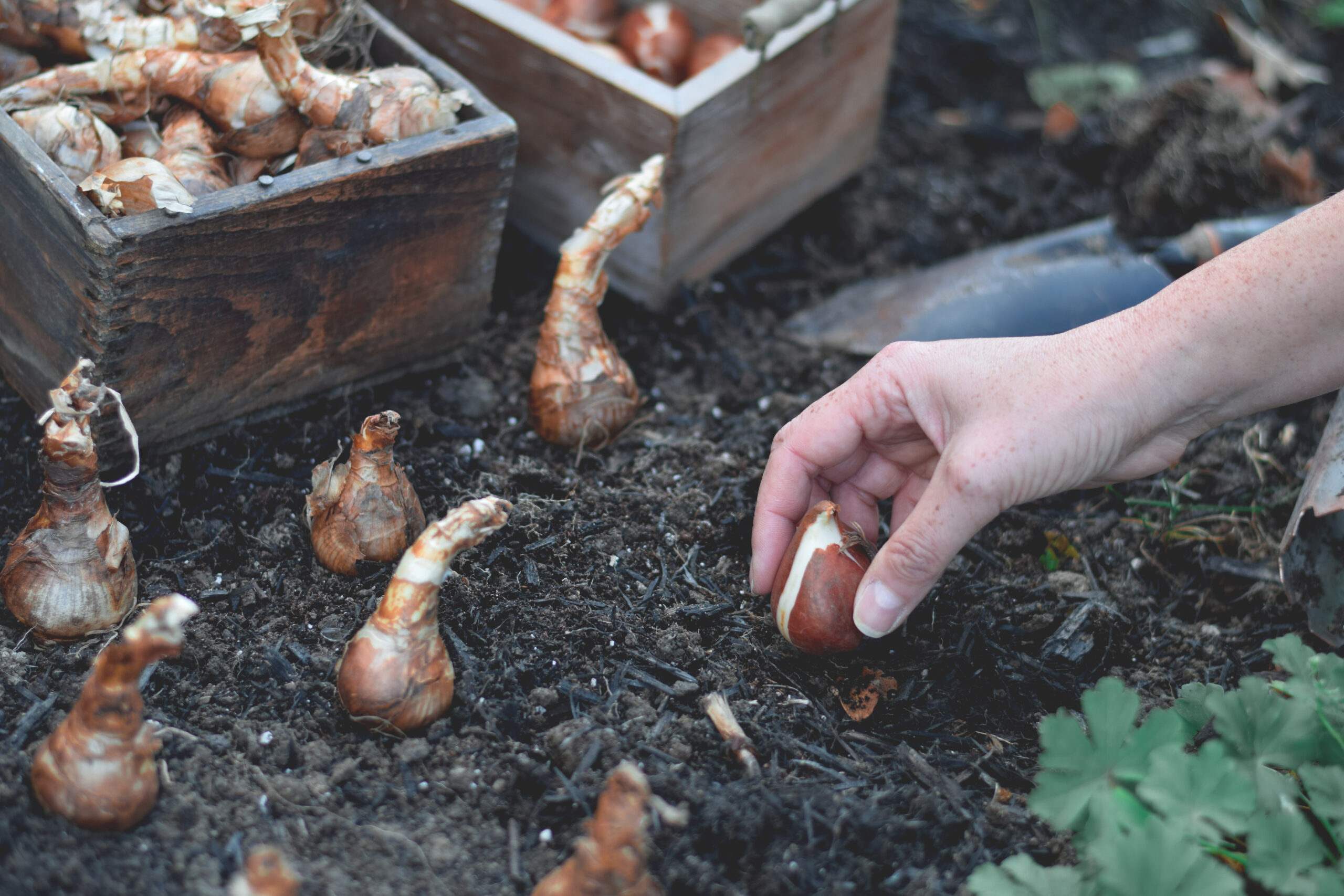
- Dig the hole or trench with a trowel, spade or bulb planter, going down to two to three times the bulb’s height.
- On heavy clay, add a layer of grit to the bottom of the hole to help drainage.
- Set each bulb in with the pointy end up and the flat base (where the roots grow from) down.
- Fill the hole back in with soil, firm it gently with your hands and water if the ground is dry.
- Mark the spot with a label so you don’t dig the bulbs up by accident before the shoots appear.
How many daffodil bulbs in one hole?
In borders, the neatest result comes from one bulb per small hole. For a quicker, more natural clump, dig one wider hole and plant groups of five to seven bulbs in it, each a bulb’s width apart. Odd numbers look less regimented.
Which way up do daffodil bulbs go?
Pointy end up. The flat end with the dry, whiskery remains of old roots goes down. If you really can’t tell, plant the bulb on its side; the shoot will find its way up.
Where to plant daffodils
Daffodils are wonderfully forgiving. They’ll grow in sun or part shade and in most garden soils as long as it isn’t waterlogged. Try them:
- In borders, planted in drifts between perennials and shrubs, where the later foliage will hide the dying leaves
- Naturalised in lawns and under deciduous trees, which let in plenty of light in early spring
- In pots and window boxes by the door
- Along paths and driveways for a welcome in spring
How to plant daffodils in pots
Use a pot at least 20 to 30cm deep with drainage holes, and fill it with multi-purpose compost mixed with a handful of grit. Plant the bulbs pointy end up, close together but not touching, and cover with about 10cm of compost. Dwarf daffodils are ideal for pots and window boxes because they don’t flop over in the wind.
For a longer display, try a bulb lasagne: layer tulips at the bottom, daffodils in the middle and crocus on top. Our guide on how to plant tulip bulbs covers the tulip layer, and you’ll find pots in our plant pots and planters range.

80 Daffodil ‘Tete-a-Tete’ Spring Bulbs
Eighty dwarf ‘Tête-à-Tête’ daffodils, perfect for pots, window boxes and the front of borders.
£13.99 Shop Now
Naturalising daffodils in grass
For a natural look, scatter bulbs across the lawn and plant them where they land using a trowel or bulb planter. Lift a flap of turf, plant the bulb at the right depth and press the turf back down. Don’t mow the area until about six weeks after the flowers fade, so the leaves can feed the bulbs for next year. Smaller, wilder-looking varieties tend to look most natural in grass.
Caring for daffodils over winter
Once they’re in the ground, daffodils need very little from you. Winter rain usually keeps the soil moist enough, so there’s no need to water bulbs in borders. Pots are different: keep an eye on them in dry spells and water if the compost feels dry a couple of centimetres down, but never let them sit in water. Raise pots on pot feet so they drain freely and don’t freeze to the patio.
After flowering
Snap off the faded flower heads so the plant puts its energy back into the bulb rather than into seeds, but leave the leaves to die back on their own for at least six weeks. Resist tying them in knots or cutting them early: the leaves are what feed next year’s flowers. A high-potash feed, such as a liquid tomato feed, after flowering helps next year’s display. You’ll find suitable options in our plant feed range.
If clumps get crowded and flower less after a few years, lift and divide them in early summer once the foliage has died down, then replant the bulbs straight away or store them somewhere cool and dry until autumn.
Why are my daffodils not flowering?
Plenty of leaves but no flowers, sometimes called ‘daffodil blindness’, usually comes down to one of a handful of things:
- Bulbs planted too shallow
- Leaves cut off or tied up too soon the previous year
- Clumps that have become overcrowded and need dividing
- Too much shade, for example under evergreen trees
- A very dry spring when the bulbs were building up for next year
Fix the cause, feed after flowering, and most clumps bounce back within a season or two.
You’ll find more ideas in our spring bulbs section.
Frequently asked questions
Is it too late to plant daffodil bulbs?
Usually not. You can plant daffodils until December, and they’ll still flower, though later and sometimes smaller. As long as the bulbs are firm and you can still dig the ground, it’s worth planting.
Can I plant daffodil bulbs in January?
Yes, if the bulbs are still firm and the ground isn’t frozen. They may flower late or not at all in the first year. Planting them in pots in a sheltered spot gives them the best chance.
Is it too late to plant if the ground has a thin layer of frost?
A light surface frost isn’t a problem if you can still dig through it. Avoid planting into frozen or waterlogged soil; pot the bulbs up instead and plant them out later.
Do I soak daffodil bulbs before planting?
No. Daffodil bulbs go in dry, straight into the soil or compost. Soaking isn’t needed and can encourage rot.
Can I plant daffodils in the spring?
Dry bulbs planted in spring are unlikely to flower that year. Instead, buy daffodils ‘in the green’ or already growing in pots and plant them straight out.
Do squirrels eat daffodil bulbs?
Rarely. Daffodils are toxic, so squirrels and mice tend to leave them alone, which makes them a good choice if tulips keep disappearing.
Are daffodils poisonous to pets?
Yes. All parts of the plant are toxic to dogs and cats, and the bulbs are the most dangerous. Store bulbs out of reach and keep an eye on dogs that like to dig.
Do daffodils come back every year?
Yes. Daffodils are reliable perennials and often multiply over the years.
Can you leave tulip bulbs in the ground all year in the UK?
Yes, in free-draining soil, though many large hybrid tulips flower less well after the first year. Daffodils are much more dependable for coming back.